

Source: Integrating spatial and temporal contexts into a factorization model for POI recommendation by Cai et. al.
What Is Matrix Factorization?
Matrix factorization answers a simple but powerful question: can a large, messy table of data be explained using a small number of hidden patterns? In machine learning, this idea appears most famously in recommendation systems (like those used by Netflix, Spotify, or Amazon) but the intuition behind it is much more general.
To understand why matrix factorization matters, let’s first look at the problem it tries to solve.
The Recommendation Problem
Imagine you run a streaming platform. You have users, you have items (movies, songs, products), and you record how users interact with those items (ratings, clicks, purchases, or watch time). This information naturally forms a table, or in mathematical terms, a matrix, where rows correspond to users, columns correspond to items, and each cell contains some interaction value.
In practice, this matrix is almost always large, sparse, and noisy. Most users interact with only a tiny fraction of all available items, leaving the majority of entries empty. Yet the business goal is clear: you want to predict the missing entries. What would a user think about an item they haven’t seen yet? That is the core of recommendation.
A simple approach might be to recommend whatever is most popular or to assume that a user’s past average rating tells you everything about their future behavior. But this quickly breaks down. People have different tastes, and items are not all alike. Two users can give the same average rating but like completely different kinds of content. Likewise, two items can have the same popularity but appeal to very different audiences.
So the real question becomes: what is driving these preferences underneath the surface?
Hidden Structure in Preferences
When someone says they “like movies,” they don’t mean all movies equally. They might enjoy action more than romance, or prefer documentaries over fantasy, or care more about emotional depth than visual spectacle. These qualities are rarely written explicitly in the dataset, but they shape every rating a user gives. Similarly, every item embodies certain characteristics: a movie may contain action, romance, humor, or suspense in varying degrees.
Matrix factorization starts with the assumption that both users and items can be described using a small number of such latent factors (hidden dimensions that capture what people care about and what items offer). A user is represented by a vector that encodes their preferences across these factors, and an item is represented by another vector that encodes how strongly it expresses each factor.
Once both users and items live in this same hidden space, predicting an interaction becomes straightforward. The compatibility between a user and an item is modeled as the dot product of their two vectors. If a user strongly prefers the kinds of attributes that an item strongly exhibits, the dot product is high, and the predicted rating is high. If their tastes and the item’s characteristics don’t align, the predicted value is low.
At a conceptual level, this is nothing more than saying: people like things that match their tastes but expressed in a mathematical form that computers can optimize.
What “Factorization” Actually Means

Source: AIML Research
We begin with the original interaction matrix R, which may be huge and mostly empty. Matrix factorization approximates this matrix as the product of two much smaller matrices:
Here, U contains one vector per user, representing that user’s preferences, and V contains one vector per item, representing that item’s attributes. Each predicted entry in R is computed by taking the dot product of the corresponding user and item vectors.
Instead of storing millions or billions of individual interactions, we store only a compact representation of users and items. The system learns these vectors by adjusting them so that their dot products closely reproduce the known ratings. This is typically done by minimizing the squared difference between predicted and actual values using gradient descent.
In other words, we are not just compressing the data but we are discovering the underlying structure that explains it.
Preferences vs. Attributes
It helps to keep the roles of users and items conceptually separate. A user’s vector captures preferences: how much they care about different hidden factors. An item’s vector captures attributes: how much that item expresses those same factors. The factors themselves are not labeled in advance; the model discovers them purely from patterns in the data.
This is why matrix factorization works even when we have no explicit information about genres, categories, or features. The system does not need to know what “action” or “romance” means. It only needs to observe that certain users consistently like the same kinds of items and that certain items tend to receive similar responses from similar users.
Mathematical Formulation
Basic Factorization Model
Let observed matrix:
Let latent dimension:
We factorize:
where user latent matrix:
and where item latent matrix:
Each entry:
Objective Function:
Because the matrix is sparse, we minimize error only over observed entries:
To avoid overfitting, we add regularization:
where:
- The set of observed entries: Ω
- Regularisation strength is: λ
- Frobenius norm : F
Bias Terms (Practical MF)
Real systems include bias terms:
where:
- Global mean: μ
- User Bias: bi
- Item Bias: bj
Optimization Methods
In machine learning, optimization means minimizing an error function. For matrix factorization, that error measures how far our predicted ratings are from the real ones.

Source: An edge detection–based eGAN model for connectivity in ambient intelligence environments by Lee et.al.
Stochastic Gradient Descent (SGD)
For each observed entry (i,j):
Update rules:
Pros: Works well on sparse data, online / incremental learning
Cons: Sensitive to learning rate
Alternating Least Squares (ALS)
Fix U, solve for V; then fix V, solve for U.
Pros: Highly parallelizable, used in large-scale systems (e.g., Spark MLlib)
Cons: Higher per-iteration cost, less flexible for implicit feedback
Applications and Use-Cases
Recommender Systems
The most well-known application of matrix factorization is in collaborative filtering, where the goal is to predict how users will interact with items they have not yet seen. This approach gained widespread recognition during the Netflix Prize competition, where factorization-based models became the dominant solution.
In practical systems, matrix factorization powers movie recommendation engines by learning what kinds of films users tend to enjoy and what kinds of attributes different movies possess. The same idea extends naturally to music platforms for personalized song discovery and to e-commerce platforms for suggesting products based on browsing or purchase behavior. In each case, users and items are embedded in a shared latent space, and recommendations emerge from the similarity between these embeddings.
Information Retrieval & Search
Matrix factorization also plays an important role in information retrieval, particularly in techniques such as Latent Semantic Analysis (LSA). Here, the original data is often a document–term matrix, where each entry records how frequently a word appears in a document. By factorizing this matrix, the model uncovers latent semantic dimensions that capture underlying topics or themes.
This allows systems to go beyond exact keyword matching and instead compare queries and documents based on meaning. As a result, matrix factorization supports semantic indexing and query–document similarity, enabling more robust search results even when different words are used to express the same idea.
Computer Vision
In Computer Vision, matrix factorization has been used for tasks such as image compression, feature extraction, and face recognition. Images can be represented as large matrices of pixel values, which often contain significant redundancy. By factorizing these matrices, it is possible to approximate images using fewer latent components, leading to efficient compression.
More importantly, the extracted latent features can serve as compact representations for recognition and classification tasks. In early vision systems, these factorized components captured recurring visual patterns, such as edges, textures, or facial structures.
Bioinformatics
Beyond recommendation and text, matrix factorization is widely applied in bioinformatics. In gene expression analysis, large matrices capture the activity levels of thousands of genes across different samples. Factorization reveals hidden biological processes and functional groupings of genes. Similarly, in protein–protein interaction prediction, it helps uncover latent structures that suggest previously unknown relationships between biological entities.
Why Matrix Factorization Works So Well
Matrix factorization succeeds because it balances simplicity with expressive power. It captures latent structure in data, identifying hidden patterns that are not directly observable. It scales effectively to massive, sparse datasets, which are common in real-world systems such as recommender platforms and search engines.
At the same time, the model remains computationally efficient and mathematically elegant. Its strong inductive bias toward low-rank structure helps prevent overfitting in many practical settings. Furthermore, the framework is flexible: it can be extended with side information such as metadata, content embeddings, or contextual features, allowing it to integrate smoothly into more complex pipelines.
Limitations of Matrix Factorization
Cold Start Problem
Matrix factorization relies entirely on historical interaction data to learn user and item representations. As a result, it struggles with new users or new items, for which no interactions exist. Without past data, the model cannot infer meaningful latent vectors.
This issue is typically addressed through hybrid approaches that incorporate side features such as user demographics, item metadata, or content-based embeddings, allowing the system to make reasonable initial predictions before sufficient interaction data is collected.
Linearity Assumption
At its core, matrix factorization models interactions as a linear dot product between user and item vectors. While this assumption enables simplicity and scalability, it limits the model’s ability to capture complex, non-linear relationships.
Modern alternatives address this limitation by introducing non-linear transformations. Neural Collaborative Filtering, Factorization Machines, and deep matrix factorization architectures extend the basic framework using neural networks, enabling richer interaction modeling at the cost of increased complexity.
Interpretability Challenges
Although matrix factorization produces meaningful internal representations, the latent dimensions themselves often lack clear semantic interpretation. Unlike explicitly defined features such as genre or price, latent factors are abstract and difficult to explain to end-users or stakeholders.
This makes it harder to provide transparent justifications for recommendations, which can be important in domains that require explainability.
Matrix Factorization vs Modern Deep Models
| Aspect | Matrix Factorization | Deep Models |
|---|---|---|
| Complexity | Low | High |
| Interpretability | Medium | Low |
| Data Requirement | Moderate | Large |
| Cold Start | Poor | Better |
| Training Cost | Low | High |
Source: AIML.com Research
Key insight: MF remains competitive when data is sparse and interpretability matters.
Conclusion
Matrix factorization is one of the most influential ideas in applied machine learning. It combines elegant mathematics with real-world scalability, forming the backbone of recommender systems and representation learning for decades.
Even in the age of deep learning, matrix factorization remains:
- A gold-standard baseline
- A building block for advanced hybrid models
- A conceptual foundation for understanding modern recommendation systems
Video Explanations
- In this video, Professor David Eisenbud, director of the Mathematical Sciences Research Institute (MSRI) explains Matrix Factorization. (Runtime: ~17 mins)

- A friendly introduction to recommender systems with matrix factorization and how it’s used to recommend movies in Netflix. (Runtime: ~33 mins)
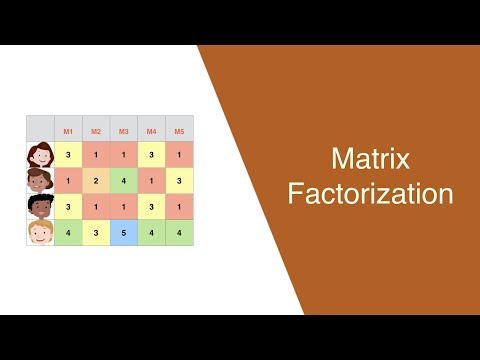
- In this tutorial, Spencer Pao provides a practical walkthrough on Building a Recommendation System in Python. He covers the end-to-end pipeline, including data preprocessing, handling sparse matrices, and implementing collaborative filtering models using popular data science libraries. (Runtime: ~14 mins)

References
- Koren et al. (2009) Matrix Factorization Techniques for Recommender Systems IEEE Computer: https://ieeexplore.ieee.org/document/5197422
- Hastie et al. (2009) The Elements of Statistical Learning Springer: https://web.stanford.edu/~hastie/ElemStatLearn/
- Lee & Seung (1999) Learning the Parts of Objects by Non-Negative Matrix Factorization Nature: https://www.nature.com/articles/44565
- Hu et al. (2008) Collaborative Filtering for Implicit Feedback Datasets IEEE ICDM: http://yifanhu.net/PUB/cf.pdf